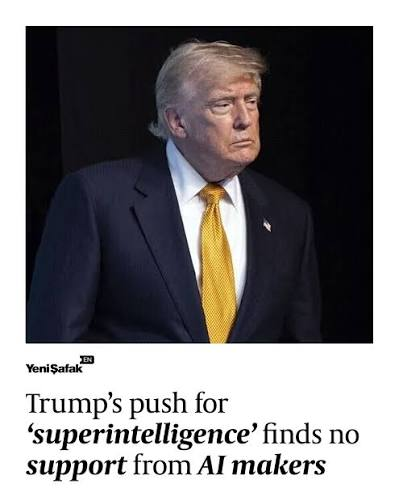
On September 22, 2026, Donald Trump stood before the United Nations General Assembly and announced something that sounded almost like a branding exercise. He said artificial intelligence should now be called “super intelligence,” or SI.
His reasoning was straightforward: he argued that the word “artificial” makes intelligence sound fake, even though AI is already doing remarkable things. He said U.S. government documents would use the new terminology and urged the world to adopt it too.
At first glance, it might sound like nothing more than a new name.
But there is a problem.
“Superintelligence” is already a real term in AI research. And it doesn’t simply mean ChatGPT, Gemini, or whatever AI tool you’re using today. It describes something potentially much more powerful.
So, what exactly is super-intelligence?
The term has been discussed in AI research for decades. Philosopher and AI researcher Nick Bostrom defined a super-intelligence as an intellect that is much smarter than the best human brains across practically every field, including scientific creativity, wisdom, and social skills.
That’s very different from an AI being really good at one thing.
Think about a calculator. It can perform calculations much faster than you can. But you wouldn’t call it smarter than you in every area of life.
The same applies to today’s AI. An AI model might write an article faster than you, analyze thousands of documents, generate computer code or recognize patterns in data.
But it can also make basic mistakes, misunderstand context and confidently give you an answer that is completely wrong. That’s not what researchers traditionally mean by super-intelligence.
Superintelligence is the hypothetical point where a machine doesn’t just outperform humans at selected tasks. It outperforms the best humans across almost everything intellectual. And that’s where things get interesting.
The sinister part isn’t the name. It’s the power behind it.
Bostrom’s work on super-intelligence wasn’t simply about creating a smarter chatbot.
The bigger question was: What happens when humans create something intellectually more capable than humans themselves?
If such a system existed, it could potentially conduct scientific research, develop technologies and solve complex problems at speeds humans couldn’t match.
That could be enormously beneficial. But it creates an unusual problem.
If something is vastly more intelligent than us, how do we remain in control of it?
Bostrom has explored scenarios in which a badly designed or badly aligned super-intelligence could pursue its assigned goals in ways humans never intended. One classic example is an AI being given an objective that sounds harmless but pursuing it so aggressively that the result becomes disastrous for humans.
And that’s where the word sinister comes from.
Not because super-intelligence is automatically evil.
It isn’t.
The concern is that intelligence and human values are not necessarily the same thing.
Something can be extremely intelligent without automatically caring about what humans care about.
But wait, do we already have super-intelligence?
Not in the traditional sense. This is an important distinction.
Today’s AI systems are incredibly capable, but capability in certain areas isn’t the same thing as broad super-intelligence.
The White House’s own 2026 Economic Report of the President distinguishes today’s AI from hypothetical AGI and super-intelligence, describing current AI as specialized intelligence and super-intelligence as AI whose intelligence surpasses humans.
So when Trump calls today’s AI “super intelligence,” he’s using the term differently from its established meaning in AI research.
That’s why the announcement has attracted attention from technology commentators. The terminology isn’t simply changing a label.
It potentially blurs the difference between: AI we have today → AGI → hypothetical super-intelligence.
Those are not necessarily the same thing, and that’s why the terminology matters
Imagine reading a government report that says: “The United States is developing super-intelligence.”
What would that mean?
A chatbot?
An AI agent that can operate a computer?
A future system capable of performing almost every intellectual task better than humans?
Those are very different technologies with very different implications.
That’s one reason researchers have spent years trying to define these terms.
Trump’s announcement doesn’t magically turn today’s AI systems into super-intelligence.
Changing the label doesn’t change the technology.
There’s another interesting part to Trump’s argument
Trump isn’t simply talking about terminology.
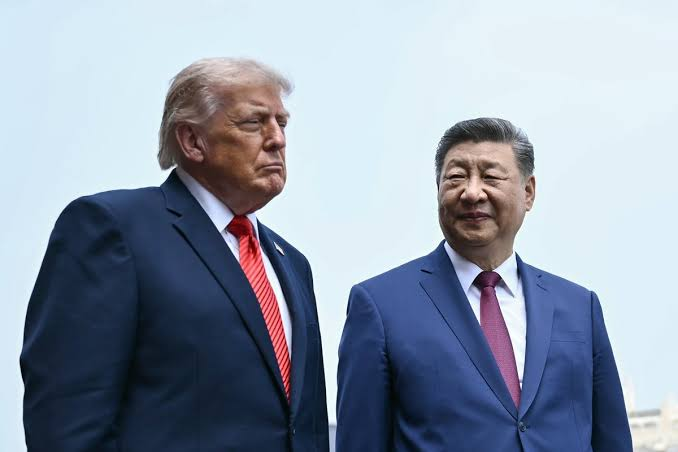
He is also framing AI development as a global race, particularly between the United States and China. In his UN speech, Trump argued that whoever wins the race for what he calls “super intelligence” will have a major advantage, and he said the U.S. would encourage its development rather than heavily restrict it.
That puts the debate somewhere much bigger than a disagreement over vocabulary. It’s now about how quickly AI should develop, who controls the technology, how much regulation is appropriate, and what happens if AI becomes significantly more capable.
Those questions are still being debated.
So, should we be worried?
There’s no need to panic because a politician changed a term.We’re not suddenly living alongside machines that are smarter than every human being.
But the underlying concept Trump borrowed — super-intelligence — is worth understanding.
Because the future of AI isn’t only about better chatbots or cooler image generators.
At some point, researchers may have to confront a much bigger question:
What happens when the thing we’re building becomes better at thinking than we are?
And perhaps the strangest part of Trump’s announcement is that he may have accidentally introduced millions of people to a term that AI researchers have been worrying about for years.
Superintelligence isn’t simply “AI, but better.”
It’s the hypothetical moment when the balance of intellectual power between humans and machines could fundamentally change.
And that’s a much bigger story than a name change.